
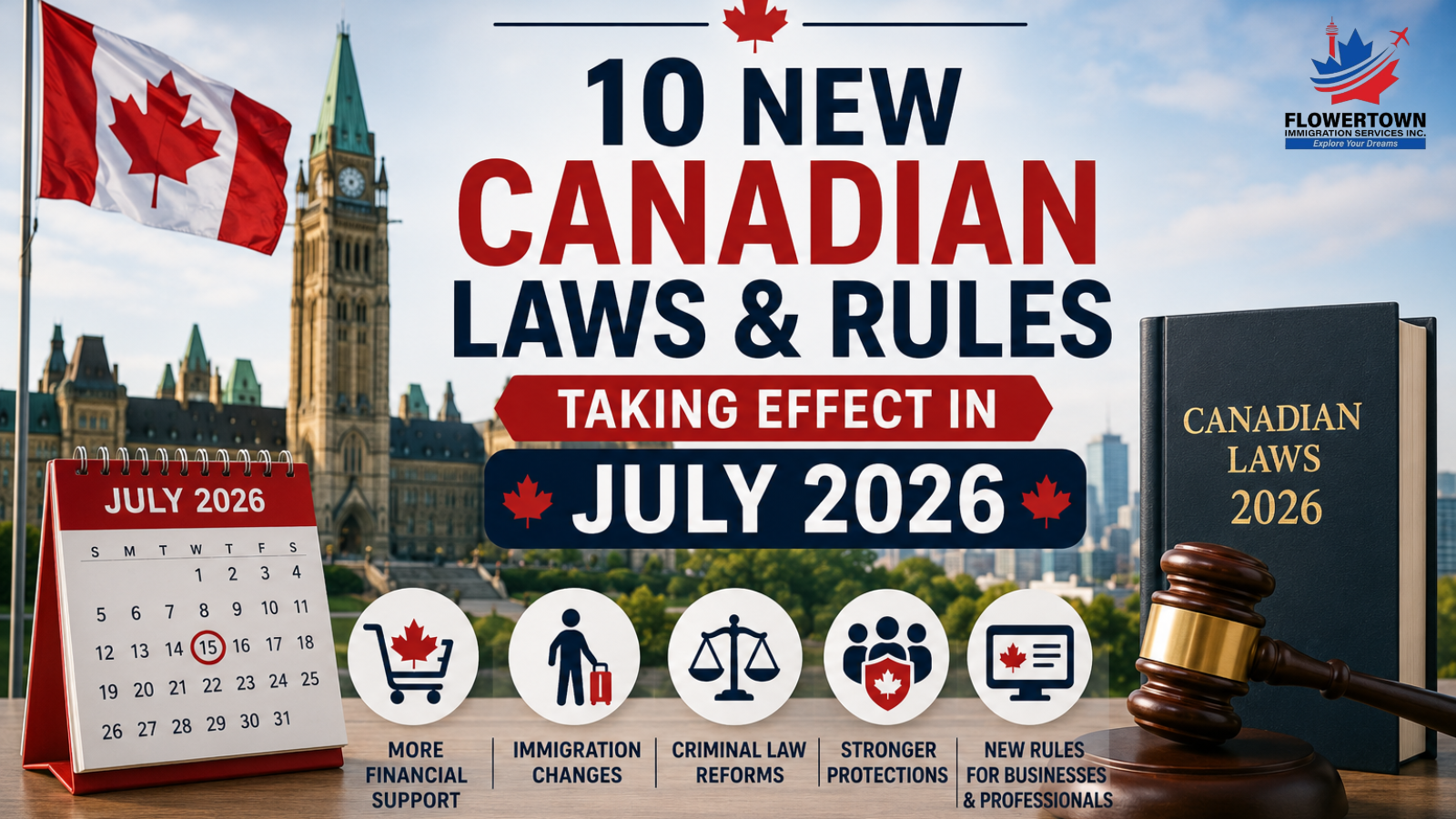
10 New Canadian Laws and Rules Taking Effect in July 2026

July 2026 brings one of the busiest months for federal policy changes Canada has seen in recent years. New criminal justice laws, a major affordability benefit, increased government payments, and tighter professional regulation are all coming into force within the same 31-day window.
Here is everything changing, who it affects, and what you need to know.
Changes That Affect Your Money
1. Canada Groceries and Essentials Benefit (July 3)
The GST/HST credit is being replaced by the Canada Groceries and Essentials Benefit. Payments increase by 25% and the program runs from 2026 through 2031. If you already receive the GST/HST credit and filed your 2025 taxes, the switch is automatic. New residents must submit Form RC151 to start receiving payments.
2. Advanced Canada Workers Benefit (July 10)
The first advance payment of the new ACWB cycle goes out July 10. Single individuals can receive up to $1,665 annually. Families can receive up to $2,869. The disability supplement adds up to $860 for eligible recipients.
3. Canada Child Benefit (July 20)
A 2% CPI increase raises the maximum CCB to $8,157 per year for children under six and $6,883 for children aged six to seventeen. Payments from July onward are calculated using your 2025 tax return, so families whose income changed between 2024 and 2025 could see a noticeable difference.
4. Canada Disability Benefit (July 20)
The maximum monthly benefit rises to $204.20. The working income exemption increases to $10,210 for single recipients and $14,294 for couples.
5. Old Age Security and GIS (July 29)
Seniors receive a 1.2% quarterly OAS increase starting July 29, the largest single quarterly adjustment of 2026. Monthly payments rise to approximately $751.97 for ages 65 to 74 and $827.17 for ages 75 and older. GIS amounts are also recalculated using 2025 income data. Seniors who have not filed their 2025 return risk having GIS payments suspended.
Changes That Affect Immigration Directly
6. Immigration Consultant Regulations Overhaul (July 15)
This is the biggest shift in how immigration consultants are regulated since the College of Immigration and Citizenship Consultants opened in 2021. Key changes include:
- A new compensation fund for clients who suffered financial losses due to a dishonest act by a licensed consultant on or after November 23, 2021
- Stronger complaint and discipline powers, including significantly higher financial penalties
- Expanded public register showing more information about each licensed consultant, starting April 2027
- Direct ministerial oversight authority, including the power to intervene with the College’s board
If you have an active immigration application, verify your consultant’s licence on the CICC public register at register.college-ic.ca before July 15.
7. Bail and Sentencing Reform Act (July 15)
Bill C-14 introduces over 80 changes to the Criminal Code. For non-citizens, the immigration consequences are direct and serious:
- Permanent residents convicted of serious indictable offences face a higher likelihood of removal orders
- Temporary residents risk immediate visa cancellation and deportation following a conviction
- Bail hearings held after July 15 may be assessed under the new, stricter rules
Anyone facing criminal charges around this date should consult both a criminal lawyer and an immigration lawyer. The timing matters.
Other Key Changes in July 2026
8. Airline Liability Insurance Increase (July 1)
The Canadian Transportation Agency is raising the minimum liability insurance requirement for all licensed air carriers. Passenger liability coverage rises from $595,000 to $735,000 per seat. This is the first time the indexation mechanism has been applied since it was adopted. Going forward, minimum thresholds will be recalculated every two years to reflect inflation. Carriers that fail to provide updated proof of coverage before the deadline face immediate licence suspension with no grace period.
9. Combatting Hate Act (July 18)
The Combatting Hate Act received Royal Assent on June 18, 2026, and comes into force 30 days later on July 18. The Act creates three new Criminal Code offences:
- Intimidating or obstructing people from accessing places of worship, schools, and community centres
- A dedicated hate crime offence, ensuring hate-motivated conduct is charged separately rather than treated only as an aggravating factor at sentencing
- Publicly displaying terrorism symbols, the Nazi Hakenkreuz, or the Nazi double Sig-Rune
The legislation does not criminalize religious teaching, sermons, scripture, peaceful assembly, or political advocacy.
10. CRA Business Registration Online Moves Behind Sign-In (July 14)
Starting July 14, the CRA’s Business Registration Online service will only be accessible through a signed-in CRA account. All business number and program account registrations must now be completed through the CRA’s secure portal. Business owners who do not yet have a CRA account should register before July 14 and verify their identity using the Document Verification Service for immediate access.
All July 2026 Changes at a Glance
| Date | Change | What It Means |
| July 1 | Airline liability insurance increase | Passenger coverage rises from $595,000 to $735,000 per seat |
| July 1 | CRA mid-year payroll update | B.C. and P.E.I. workers may see take-home pay changes |
| July 3 | Canada Groceries and Essentials Benefit | Replaces GST/HST credit with a 25% payment increase |
| July 10 | Advanced Canada Workers Benefit | First advance payment using 2025 tax return data |
| July 14 | CRA Business Registration Online | Access moves behind a signed-in CRA account only |
| July 15 | Bail and Sentencing Reform Act | Over 80 Criminal Code changes; serious immigration consequences for non-citizens |
| July 15 | CICC Immigration Consultant Regulations | Compensation fund, higher penalties, expanded public register |
| July 18 | Combatting Hate Act | New hate crime offences and protections for identifiable groups |
| July 20 | Canada Child Benefit and Canada Disability Benefit | Both increase with CPI adjustment using 2025 tax data |
| July 29 | OAS and GIS increase | Largest single quarterly OAS adjustment of 2026 |
What You Should Do Before July?
- File your 2025 tax return now if you have not. The CRA cannot recalculate your CCB, CGEB, ACWB, GIS, or CDB without it
- Check your pay stub after the first July payroll if you work in British Columbia or Prince Edward Island
- Verify your immigration consultant’s licence on the CICC public register at register.college-ic.ca before July 15
- Non-citizens facing criminal charges should get immigration legal advice immediately. Convictions after July 15 carry heavier consequences under the new sentencing framework
- Seniors should compare their June and July deposits carefully. The combined OAS increase and GIS recalculation can produce a noticeably different total
Frequently Asked Questions
Do I need to apply separately for the Canada Groceries and Essentials Benefit?
No. If you already receive the GST/HST credit and have filed your 2025 return, the CRA transitions you automatically. The July 3 deposit will reflect the new program and the 25% increase. New residents who have never received the GST/HST credit must submit Form RC151.
How does the Bail and Sentencing Reform Act affect my immigration status?
For permanent residents, a conviction under the tougher sentencing framework raises the likelihood of a removal order. Temporary residents risk visa cancellation and deportation. If you are a non-citizen facing charges around July 15, speak with an immigration lawyer alongside any criminal defence counsel.
My immigration consultant handled my case before 2021. Does the new compensation fund cover me?
No. The compensation fund covers financial losses from dishonest acts committed on or after November 23, 2021. Losses from before that date fall outside the fund’s scope.