
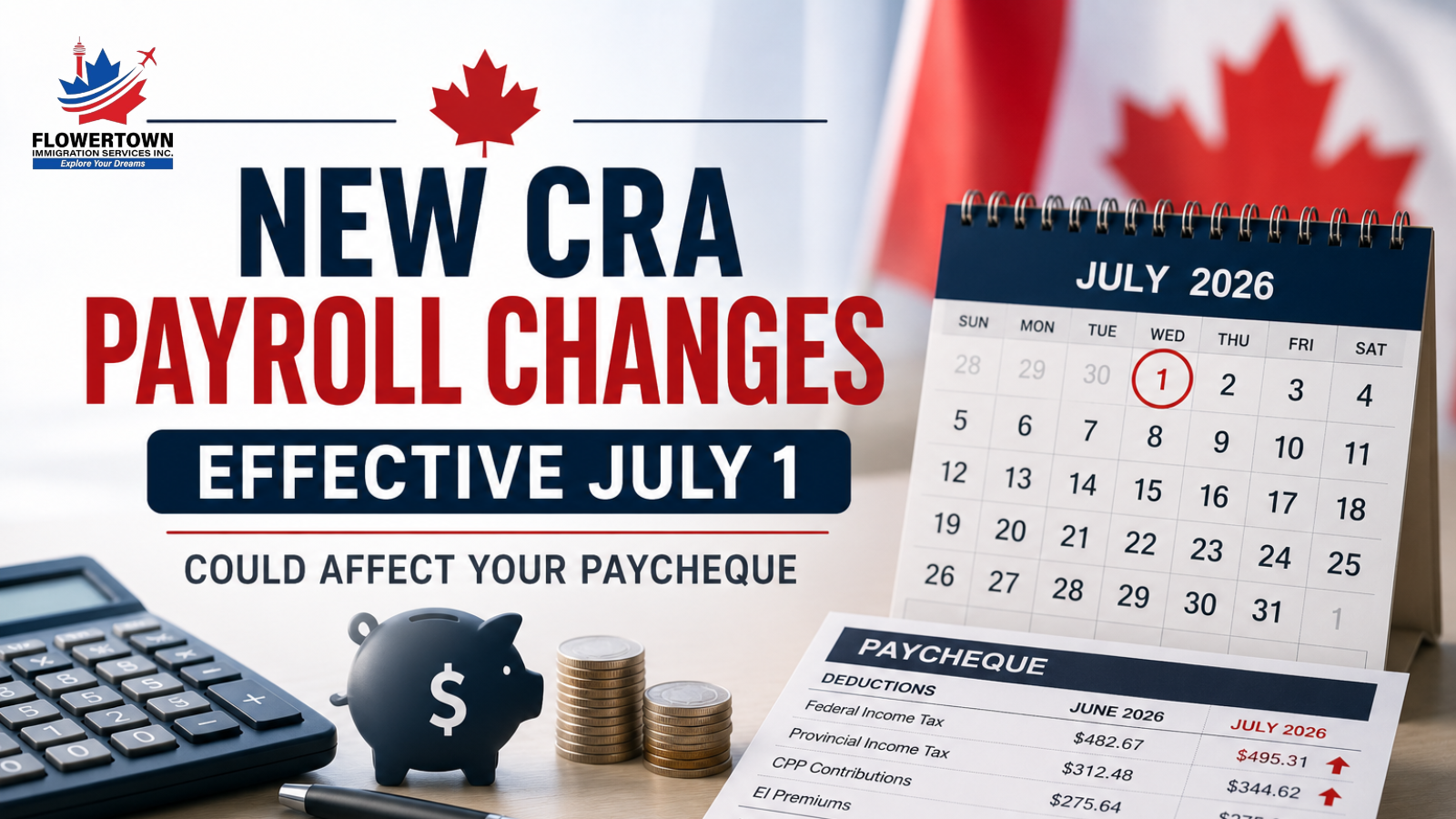
New CRA Payroll Changes Effective July 1 Could Affect Your Paycheque

Your July paycheque might look a little different. The Canada Revenue Agency has released updated payroll deduction formulas and tables effective July 1, 2026, and depending on where you work and what you earn, the change could show up on your next pay stub.
This is not unusual. The CRA publishes its T4127 Payroll Deductions Formulas guide twice a year, once in January and once in July, to capture tax changes that were not yet law when the January edition was finalized. Provincial budgets often land in February or March, which is exactly why the mid-year update exists.
Who Is Most Likely to Notice a Difference?
Workers in British Columbia are the most directly affected this July. The B.C. government raised the lowest provincial income tax rate from 5.06% to 5.60%, retroactive to January 1, 2026. Because employers were still using the old rate for the first half of the year, the July T4127 applies a prorated rate of 6.14% from July through December to make up the difference. According to the CRA’s T4127 guide, this prorated approach ensures the correct annual provincial tax is collected across all 12 months.
In practical terms: B.C. workers will see slightly higher provincial tax deductions on each paycheque from July to December. This is by design, not an error.
B.C. also increased its basic tax reduction from $562 to $690 for 2026, which partially offsets the rate increase for lower-income workers.
Workers in Ontario, Alberta, Saskatchewan, Manitoba, New Brunswick, Nova Scotia, and the territories are less likely to see any change. No mid-year provincial tax adjustments were announced in those regions.
Quebec is administered separately by Revenu Québec and follows its own provincial tables.
What the Numbers Look Like in 2026?
Here are the key payroll parameters currently in effect, as published by the CRA:
| Parameter | 2026 Amount |
| Federal basic personal amount | $16,452 |
| Lowest federal income tax rate | 14% |
| CPP employee contribution rate | 5.95% |
| CPP maximum pensionable earnings (YMPE) | $74,600 |
| CPP2 rate (earnings $74,600 to $85,000) | 4.00% |
| Maximum CPP employee contribution | $4,646.45 |
| EI premium rate (outside Quebec) | $1.63 per $100 |
| EI maximum insurable earnings | $68,900 |
| Maximum EI employee premium | $1,123.07 |
| B.C. lowest rate (prorated from July 1) | 6.14% |
The 14% lowest federal tax rate has been in place since January 1, 2026, under the Making Life More Affordable for Canadians Act. That rate does not change at mid-year.
Neither CPP nor EI rates change on July 1. Both are set annually in January and remain fixed for the full calendar year. Workers who have already hit their maximum CPP contributions at the $74,600 ceiling will see those deductions stop, which often produces a noticeable bump in net pay later in the year.
How to Check If Your Paycheque Changed?
Compare your last June 2026 pay stub to your first July 2026 pay stub. Look specifically at:
- Federal income tax withheld
- Provincial income tax withheld
- CPP contributions
- EI premiums
If your gross pay stayed the same but any of these line items shifted, the July T4127 update is the reason.
The CRA’s Payroll Deductions Online Calculator has already been updated to reflect July 1, 2026 values. You can enter your province, gross pay, and claim code to see exactly what deductions the CRA expects on your next cheque.
If you think your employer is withholding too much or too little, you can submit a new TD1 Personal Tax Credits Return to adjust your credits.
A Note for Employers
The CRA expects every employer and payroll provider to load the updated July 2026 T4127 and T4032 tables before processing the first payroll of the month. Most major payroll platforms push these updates automatically, but a manual check is recommended. Failing to use the correct formulas can result in under-withholding or over-withholding, which creates issues for both the employer and the employee at tax filing time. Small businesses using spreadsheet-based payroll should download the latest T4032 Payroll Deductions Tables directly from the CRA website.
Frequently Asked Questions
Will every Canadian worker see their paycheque change on July 1?
No. The update primarily affects workers in British Columbia, where a provincial tax rate change was announced after the January edition of the T4127 was published. Workers in most other provinces are unlikely to notice a difference unless their personal circumstances changed, such as a raise, a bonus, or an updated TD1 form.
Did the federal tax rate change again on July 1, 2026?
No. The lowest federal income tax rate was set at 14% on January 1, 2026, under the Making Life More Affordable for Canadians Act. That rate carries forward without any mid-year adjustment.
I work in B.C. My provincial tax looks higher than June. Is something wrong?
No. The CRA is applying a prorated rate of 6.14% for July through December to account for the lower 5.06% rate that was used during the first half of the year. This is the CRA’s standard approach for retroactive provincial tax changes, as outlined in the T4127 guide. Your annual provincial tax will work out correctly at filing time.